

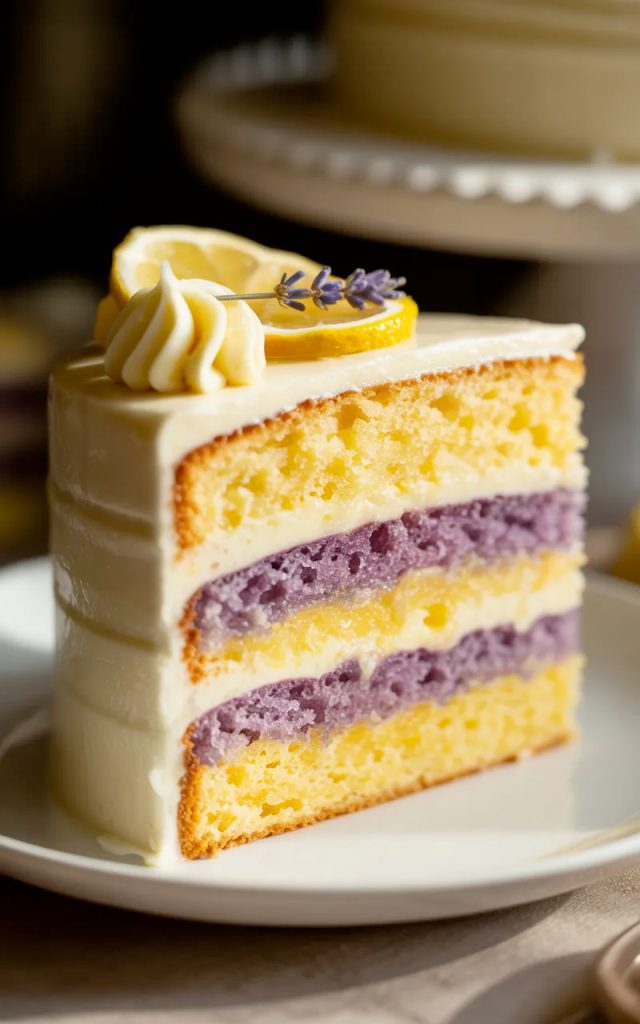

There are cakes that taste good and there are cakes that make people genuinely stop and stare before they even think about cutting into them. This lemon lavender cake is firmly in the second category.
Bright yellow lemon cake layers alternating with delicate purple lavender cake layers, all filled and frosted with a smooth, creamy lemon lavender buttercream that is simultaneously tangy and floral, decorated with fresh lemon slices and dried lavender sprigs on top — it is one of the most visually striking cakes you can put on a table and every single person who sees it wants a piece immediately.
The flavor combination is genuinely special. Lemon and lavender have a natural affinity that has been celebrated in French patisserie for decades and for good reason.
The bright, acidic citrus of the lemon cuts through the floral, slightly herbaceous quality of the lavender in a way that stops either flavor from becoming overwhelming.
The result is a cake that tastes elegant and sophisticated without being strange or inaccessible — people who are initially skeptical about lavender in a dessert consistently come around after the first bite.
This is the cake for a special occasion, a milestone birthday, a spring or summer celebration, or any moment that deserves something genuinely extraordinary. Let’s get into it.
Why you’ll love this recipe
- The alternating lemon and lavender layers are visually breathtaking. When you cut into this cake and reveal the alternating yellow and purple layers with white buttercream between each one, the cross-section is genuinely one of the most beautiful things in cake baking. People will reach for their phones before they reach for a fork.
- The lemon and lavender flavor combination is sophisticated and completely irresistible. Bright, tangy lemon and delicate floral lavender are a pairing that feels elegant and special. It is familiar enough to be approachable and distinctive enough to be memorable.
- The lemon lavender buttercream is extraordinary. Silky smooth, tangy from the lemon, subtly floral from the lavender — this buttercream is so good that people will eat it with a spoon straight from the bowl given the opportunity. FYI I speak from experience on this one.
- It looks like a professional bakery cake. The horizontal ridged buttercream texture on the outside, the fresh lemon slices, the piped rosettes, and the lavender sprigs on top create a professional-looking finish that is achievable at home with an offset spatula and a bench scraper.
- Perfect for celebrations. Spring birthdays, bridal showers, baby showers, Mother’s Day, Easter — this cake fits every spring and summer celebration perfectly and makes a genuinely unforgettable centerpiece.
- The individual components can all be made ahead. The cake layers, the buttercream, and even the assembled cake can all be prepared in advance which makes this a manageable bake even for a busy celebration week.
Ingredients with key notes
For the lemon cake layers:
- 2.5 cups all-purpose flour — Spoon and level for accurate measurement.
- 2.5 tsp baking powder
- 1/2 tsp salt
- 1 cup unsalted butter, softened — Room temperature. Properly softened butter is essential for a properly creamed batter.
- 2 cups granulated sugar — Creamed thoroughly with the butter for the right lift and tender crumb.
- 4 large eggs, room temperature
- 1 tbsp lemon zest — Use a microplane for the finest zest. The zest contains the essential oils that carry the most intense lemon flavor — do not skip it or substitute with extra juice.
- 3 tbsp fresh lemon juice — Always freshly squeezed. Bottled lemon juice lacks the brightness of fresh.
- 1 tsp pure vanilla extract
- 1 cup whole milk, room temperature — Whole milk for the richest, most tender crumb.
- Yellow food coloring — optional — A drop or two deepens the natural yellow of the lemon layer if you want a more dramatic color contrast between the layers.
For the lavender cake layers:
- Use the same batter as the lemon layers with these modifications:
- Omit the lemon zest and lemon juice — Replace the lemon juice with an equal amount of whole milk.
- Add 2 tsp dried culinary lavender, finely ground — This is the key ingredient. Make sure you are using culinary grade lavender — not decorative lavender which may be treated with chemicals. Grind the dried lavender in a spice grinder or mortar and pestle until fine before adding to the batter.
- Add 1 tsp lavender extract — Optional but adds a more pronounced lavender flavor. Available at specialty grocery stores and online.
- Purple food coloring — A small amount creates that beautiful distinctive lavender purple color in the cake layer. Add gradually and mix until you reach a soft pastel purple shade.
For the lemon lavender buttercream:
- 2 cups unsalted butter, softened — The foundation of the buttercream. Properly softened — not melted and not cold.
- 6 cups powdered sugar, sifted — Sifting prevents a lumpy buttercream. Add gradually.
- 3 tbsp fresh lemon juice — Adds the bright tangy lemon flavor to the buttercream.
- 1 tsp lemon zest
- 1 tsp dried culinary lavender, finely ground — Infuses a delicate floral note throughout the buttercream.
- 3-4 tbsp heavy cream — For achieving the right smooth, spreadable consistency.
- 1 tsp pure vanilla extract
- Pinch of salt
For decoration:
- Fresh lemon slices or thin rounds
- Dried culinary lavender sprigs
- Extra buttercream for piped rosettes
Step-by-step instructions
Step 1 — Make the lavender simple syrup (optional but recommended)
Combine half a cup of water, half a cup of sugar, and a tablespoon of dried culinary lavender in a small saucepan over medium heat. Stir until the sugar dissolves then remove from heat and let the lavender steep for 20 minutes. Strain and let cool. Brushing this simple syrup lightly over the cake layers before assembling adds extra moisture and a more pronounced lavender flavor. Set aside.
Step 2 — Preheat and prep
Preheat your oven to 350°F. Grease four 8-inch round cake pans — or work in batches if you only have two — and line the bottoms with parchment paper circles. Grease the parchment as well.
Step 3 — Make the base cake batter
In the bowl of a stand mixer fitted with the paddle attachment, beat the softened butter and sugar on medium speed for 4-5 minutes until very light and fluffy. Add the eggs one at a time, beating well after each addition. Add the vanilla extract and mix to combine. In a separate bowl whisk together the flour, baking powder, and salt. With the mixer on low, add the flour mixture in three additions alternating with the whole milk in two additions, beginning and ending with the flour. Mix until just combined.
Step 4 — Divide and flavor the batters
Divide the batter evenly into two bowls. To the first bowl add the lemon zest, fresh lemon juice, and a drop or two of yellow food coloring if using. Fold gently to combine — this is your lemon batter. To the second bowl add the finely ground dried lavender, lavender extract if using, and enough purple food coloring to achieve a soft pastel purple shade. Fold gently to combine — this is your lavender batter.
Step 5 — Bake the cake layers
Divide each flavored batter evenly between two prepared cake pans — you should end up with two lemon layer pans and two lavender layer pans. Smooth the tops with an offset spatula. Bake at 350°F for 26-30 minutes until a toothpick inserted in the center comes out clean and the tops spring back lightly when pressed. Let cool in the pans on wire racks for 15 minutes then turn out onto racks to cool completely. If you baked in batches, let the pans cool completely before baking the second batch.
Step 6 — Make the lemon lavender buttercream
Beat the softened butter on medium-high speed for 4-5 minutes until very pale and fluffy. Add the finely ground lavender and lemon zest and beat for another minute. Add the sifted powdered sugar one cup at a time on low speed until incorporated. Add the lemon juice, heavy cream, vanilla extract, and pinch of salt. Beat on high speed for 3-4 minutes until the buttercream is very smooth, fluffy, and spreadable. Taste and adjust — add more lemon juice for more tang or more cream to loosen the consistency.
Step 7 — Level the cake layers
Once all four layers are completely cool, use a serrated knife or cake leveler to level the tops of each layer so they are flat and even. Flat layers stack more stably and give you cleaner lines in the finished cake. The trimmings are the baker’s reward — snack on them and consider it a quality check.
Step 8 — Assemble the cake
Place the first lemon layer on a cake board or serving plate. If using the lavender simple syrup, brush a thin layer over the surface using a pastry brush. Spread a generous even layer of lemon lavender buttercream over the top. Place the first lavender layer on top. Brush with syrup and spread another generous layer of buttercream. Repeat with the second lemon layer, then finish with the second lavender layer on top. Press down very gently to ensure the layers are level and stable.
Step 9 — Crumb coat and chill
Apply a thin crumb coat of buttercream all over the outside of the assembled cake — top and sides — to seal in any loose crumbs. Smooth it as best you can but do not worry about perfection at this stage. Refrigerate for 30 minutes until the crumb coat is firm to the touch.
Step 10 — Apply the final buttercream coat
Apply the final coat of buttercream generously over the chilled crumb coat. For the ridged horizontal texture visible in the photos, use a bench scraper held straight against the side of the cake while rotating the cake on a turntable — the scraper will create even, clean horizontal lines. Smooth the top with an offset spatula.
Step 11 — Decorate and finish
Transfer the remaining buttercream to a piping bag fitted with a star tip and pipe rosettes around the top edge of the cake. Place fresh lemon slices decoratively across the top — you can overlap them slightly or arrange them in a cluster in the center. Tuck small sprigs of dried culinary lavender between and around the lemon slices. Refrigerate for at least 30 minutes before slicing to allow the buttercream to firm up and the cake to hold its shape cleanly when cut.
Serving suggestions
This lemon lavender cake is a complete and stunning dessert on its own but here are a few ways to make the experience even more special:
- With a cup of Earl Grey or chamomile tea — The floral, slightly citrusy notes of Earl Grey tea are a natural companion for the lemon lavender flavors in this cake. A proper afternoon tea setup with this cake as the centerpiece is genuinely special.
- With a glass of Champagne or Prosecco — For a celebration, the effervescence and slight sweetness of Champagne alongside this elegant cake is a pairing that feels completely appropriate for the occasion.
- With fresh berries on the side — A small pile of fresh raspberries or blueberries alongside each slice adds a fresh, tart counterpoint and enhances the visual appeal of the plate.
- At a spring bridal or baby shower — This cake is tailor-made for a spring celebration. Set it on a cake stand surrounded by fresh flowers and it becomes an instant talking point and a genuinely memorable centerpiece.
- With a lavender lemonade — Serve each guest a glass of homemade lavender lemonade alongside their slice for a cohesive flavor experience that ties the whole celebration together.
Storage tips
Room temperature: The assembled and frosted cake can sit at room temperature for up to 2 hours before serving. Beyond that, refrigerate it.
Refrigerator: Store the assembled cake loosely covered with plastic wrap or in a cake box in the fridge for up to 4 days. The buttercream may firm up considerably in the fridge — bring the cake to room temperature for at least 30 minutes before serving for the best flavor and texture.
Individual cake layers: Baked and completely cooled cake layers can be wrapped tightly in plastic wrap and stored at room temperature for 2 days or refrigerated for up to 5 days before assembling.
Freezing cake layers: Wrap individual cooled layers tightly in plastic wrap and then in aluminum foil and freeze for up to 2 months. Thaw overnight in the fridge still wrapped before assembling. The lemon and lavender flavors actually deepen slightly after freezing and thawing.
Buttercream storage: The lemon lavender buttercream can be made up to 5 days in advance and stored in an airtight container in the fridge. Bring to room temperature and re-whip for 2-3 minutes before using — cold buttercream does not spread or pipe well.
Wrapping it up
Lemon lavender cake is the kind of bake that creates a genuine moment — when it comes out of the fridge decorated and ready to serve and everyone in the room turns to look at it.
The alternating layers, the elegant buttercream, the lemon slices, the lavender sprigs — it is a cake that communicates care and creativity and love without saying a single word.
Make it for someone special, make it for a celebration that deserves something extraordinary, or make it just because you want to create something beautiful. Give it a try and let me know how it turns out — happy baking 🙂
Lemon lavender cake — the elegant, floral layer cake that is as stunning to look at as it is to eat
Description
Tender butter cake split into lemon and lavender flavored layers — bright yellow lemon layers with fresh lemon zest and juice and delicate purple lavender layers with ground culinary lavender — filled and frosted with a silky lemon lavender buttercream and decorated with fresh lemon slices dried lavender sprigs and piped rosettes.
Ingredients
For the lemon cake layers:
For the lavender cake layers (same base batter with modifications):
For the lemon lavender buttercream:
For decoration:
Instructions
-
Optional — make lavender simple syrup by simmering water sugar and culinary lavender then straining and cooling.
-
Preheat oven to 350°F. Grease and line four 8-inch round cake pans with parchment paper.
-
Beat butter and sugar for 4-5 minutes until very light and fluffy. Add eggs one at a time. Add vanilla. Alternately add flour mixture in three additions and milk in two beginning and ending with flour.
-
Divide batter into two bowls. Add lemon zest juice and yellow coloring to one bowl for lemon batter. Add ground lavender lavender extract and purple coloring to second bowl for lavender batter.
-
Divide each batter between two pans. Bake for 26-30 minutes until toothpick comes out clean. Cool in pans 15 minutes then transfer to wire racks to cool completely.
-
Beat butter for 4-5 minutes until pale and fluffy. Add ground lavender and lemon zest. Add powdered sugar gradually. Add lemon juice cream vanilla and salt. Beat on high for 3-4 minutes until smooth and fluffy.
-
Level all four cake layers with a serrated knife.
-
Assemble alternating lemon and lavender layers with generous buttercream between each layer. Brush with syrup if using.
-
Apply a thin crumb coat. Refrigerate 30 minutes.
-
Apply final buttercream coat with ridged texture using a bench scraper. Pipe rosettes around the top. Decorate with lemon slices and lavender sprigs. Refrigerate 30 minutes before slicing.