
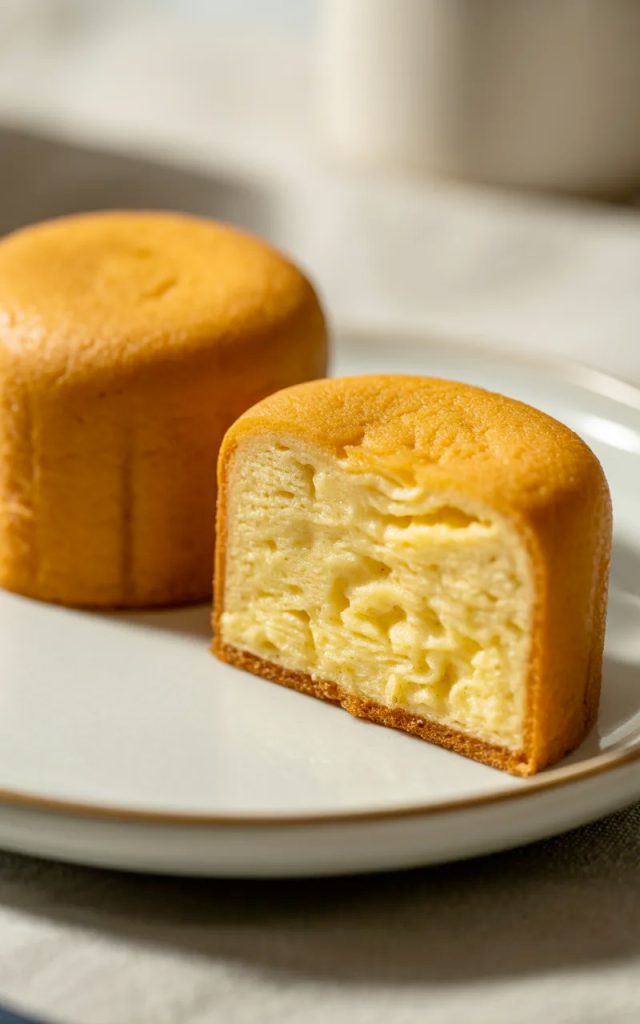
I have a habit of stopping dead in my tracks at Asian bakeries. There is always something in the display case that I have never seen before, something that looks deceptively simple but somehow more interesting than everything else in the room. The first time I encountered Ji Dan Gao — Chinese egg cake — it was exactly that kind of moment.
Small, round, deeply golden on the outside, with a cross-section that showed the most impossibly light and airy yellow sponge I had ever seen. I bought one without knowing what it was, took a bite, and genuinely could not figure out how something so simple tasted so good. No frosting, no filling, no elaborate decoration. Just a perfectly baked little cake that was light as air and quietly, completely satisfying.
When I got home I went straight to my kitchen and started researching. The ingredient list surprised me — eggs, sugar, flour, a little vanilla, a neutral oil. That is essentially it.
The magic, I discovered, is entirely in the technique. Specifically, in whipping the eggs and sugar to the right consistency before anything else goes into the batter. Get that right and the rest practically takes care of itself. This recipe breaks the whole process down so you can nail it on your first try.
For the Chinese Egg Cake:
Key Notes:
Eggs — Room temperature eggs are absolutely non-negotiable for this recipe. Cold eggs do not whip to the same volume as room temperature eggs, and volume is everything in Ji Dan Gao. The whipped eggs are the entire structural foundation of this cake — they provide the lift, the airiness, and the light texture that makes this cake what it is. Take your eggs out of the fridge at least 30 minutes before you start, or place them in a bowl of warm water for 10 minutes if you forget.
Sugar — Three quarters of a cup gives you a cake that is pleasantly sweet without being cloying. The sugar does more than just sweeten here — it dissolves into the whipped eggs during the beating process and contributes to the stability of the foam. Do not reduce the sugar significantly or the structure of the batter will suffer.
Cake Flour — Cake flour has a lower protein content than all purpose flour, which produces a more tender, delicate crumb. It is what gives Ji Dan Gao that characteristic soft, fine texture. If you cannot find cake flour, you can substitute all purpose flour that has been sifted twice — the double sifting aerates the flour and gets you closer to the light texture cake flour provides. Do not skip the sifting step if you go this route.
Baking Powder — Just half a teaspoon provides a small amount of additional lift to support the whipped egg structure. Make sure yours is fresh. Tap the lid and check the date — old baking powder is one of the most common reasons baked goods come out denser than they should.
Neutral Oil — A few tablespoons of neutral oil adds just enough moisture and richness to the batter without weighing it down or introducing a competing flavor. Vegetable oil, sunflower oil, or light flavored coconut oil all work well. Do not use olive oil or any strongly flavored oil — the flavor will fight with the delicate vanilla and egg flavor of the cake.
Vanilla Extract — One teaspoon of good quality vanilla rounds out the flavor beautifully. The flavor of Ji Dan Gao is intentionally subtle and delicate — the vanilla enhances that without overpowering it. If you want to be more traditional, you can omit the vanilla entirely or substitute a small amount of pandan extract for a beautiful green color and gently floral flavor.
Step 1 — Preheat and Prepare Your Pan
Preheat your oven to 350 degrees F (175 degrees C). Grease your muffin tin or individual round cake molds generously with oil or non-stick spray, then line the bottoms with small circles of parchment paper. This ensures the cakes release cleanly and maintain their beautiful domed shape.
If you are making individual egg cakes in a muffin tin, this recipe makes approximately 8-10 cakes depending on the size of your tin. If you prefer one larger cake, use an 8 inch round cake pan lined with parchment.
Step 2 — Sift the Flour
Sift the cake flour, baking powder, and salt together into a bowl. Set aside. If you are using all purpose flour, sift it twice before measuring to aerate it properly. This step takes less than two minutes and makes a noticeable difference in the final texture of the cake. Do not skip it.
Step 3 — Whip the Eggs and Sugar
This is the most important step in the entire recipe and it deserves your full attention. Add the room temperature eggs and granulated sugar to a large bowl. Using an electric hand mixer or a stand mixer fitted with the whisk attachment, beat on medium-high speed for 8-10 minutes.
You are looking for a very specific consistency — the mixture should triple in volume, turn a very pale almost white yellow, and reach what bakers call the ribbon stage. To test for the ribbon stage, lift the beaters and let the batter fall back into the bowl. It should fall in a thick, slow ribbon that holds its shape on the surface for at least 3-4 seconds before sinking back in.
Do not rush this step and do not under-whip. An under-whipped egg mixture is the single most common reason Ji Dan Gao comes out dense rather than light. If you are not sure, keep whipping for another two minutes.
Step 4 — Add the Vanilla and Oil
Add the vanilla extract and neutral oil to the whipped egg mixture. Using a rubber spatula, fold them in with gentle, deliberate strokes. You want to incorporate the oil and vanilla without deflating the air you just spent 8-10 minutes building into those eggs. Be patient and fold rather than stir.
Step 5 — Fold in the Flour
Add the sifted flour mixture to the bowl in two additions. Fold each addition in gently with a rubber spatula using a bottom-to-top motion — scrape along the bottom of the bowl and fold the batter up and over itself. Rotate the bowl slightly with each fold to make sure everything gets incorporated evenly.
Stop folding as soon as you no longer see dry flour streaks. Over-mixing at this stage will deflate the batter and develop the gluten in the flour, both of which will give you a denser, tougher cake. A few gentle folds and you are done.
Step 6 — Fill the Molds and Bake
Pour or spoon the batter into your prepared molds, filling each one about three quarters full. Tap the pan gently on the counter once or twice to release any large air bubbles.
Place in the preheated oven and bake for 18-22 minutes, until the tops are deeply golden and a toothpick inserted into the center comes out clean. The cakes will dome beautifully in the oven — that is exactly what you want.
Do not open the oven door during the first 15 minutes of baking. The sudden change in temperature can cause the cakes to collapse before they have set properly.
Step 7 — Cool and Unmold
Remove from the oven and let the cakes cool in the pan for 5 minutes. Then run a thin knife or offset spatula around the edges of each cake and invert them gently onto a wire cooling rack. The cakes should release cleanly thanks to the parchment lining.
Let them cool for at least 10 minutes before serving. The texture continues to set as they cool and the flavor develops further. Serve them golden side up to show off that beautiful caramelized exterior.
The most traditional way to serve Ji Dan Gao is completely plain, golden side up, alongside a cup of hot Chinese tea. The simplicity is intentional — the cake is delicate enough that it does not need any accompaniment, and the tea complements the mild sweetness beautifully.
A light dusting of powdered sugar over the golden tops adds a subtle visual elegance and a whisper of extra sweetness if you want to dress them up slightly. It takes five seconds and makes them look like they came from a proper patisserie.
Fresh fruit works wonderfully alongside these cakes. Sliced mango, fresh strawberries, or a small bowl of lychees served on the side creates a simple but genuinely lovely dessert plate that feels both fresh and festive.
If you want to take them in a slightly richer direction, serve with a small bowl of sweetened whipped cream or a scoop of vanilla ice cream. The contrast between the warm, light cake and the cold cream is a combination that works in every culture and every season.
At Room Temperature — These cakes are best eaten the day they are made while the exterior is still slightly crisp and the interior is at its lightest and most tender. If you have leftovers, store them in an airtight container at room temperature for up to 2 days. The texture softens slightly over time but the flavor remains excellent.
In the Fridge — You can refrigerate them in an airtight container for up to 4 days. Before eating, let them come to room temperature for about 15 minutes or warm them briefly in a low oven at 300 degrees F for 5 minutes to revive some of the texture.
In the Freezer — Ji Dan Gao freezes surprisingly well. Cool completely, wrap each cake individually in plastic wrap, and place in a freezer-safe bag or container. Freeze for up to 1 month. Thaw at room temperature for about an hour before serving. Do not microwave from frozen — it makes the texture gummy and unpleasant.
Make Ahead Tip — You can make these a day ahead if you are preparing for a gathering. Store at room temperature in an airtight container and they will still be excellent the next day. The golden exterior softens slightly overnight but the interior texture holds up very well.
There is something genuinely special about a recipe that achieves this much with this little. No butter, no milk, no elaborate technique beyond one critical step — and the result is a cake that is light, golden, and quietly extraordinary in a way that most more complicated desserts never manage to be.
Ji Dan Gao is one of those recipes that reminds me why I fell in love with cooking in the first place. The discovery of something unfamiliar, the curiosity to figure out how it works, the satisfaction of pulling something beautiful out of the oven that you made entirely from scratch with your own hands.
Make these on a weekend when you have a little time to enjoy the process. Brew some tea. Eat them warm. And if you try a flavor variation or put your own spin on the recipe, drop a comment below and tell me about it. I want to hear how it went.
Happy cooking.
— Kip
Ji Dan Gao is a classic Chinese egg cake with a beautifully golden exterior and an impossibly light, airy sponge interior. Made with just eggs, sugar, flour, and a touch of vanilla, this traditional cake relies entirely on properly whipped eggs for its signature fluffy texture. Simple ingredients, stunning results, and a taste that is both delicate and deeply satisfying.