

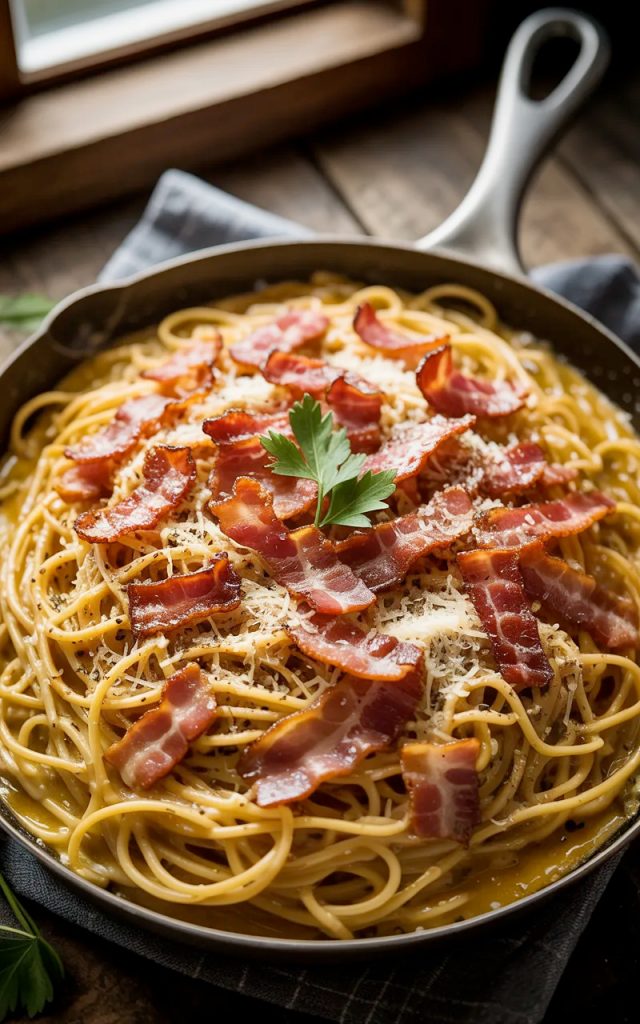

Carbonara has a reputation. People hear the name and assume it is one of those dishes that requires professional training, imported ingredients, and a very specific Italian grandmother standing in the kitchen supervising.
And I understand why — when it goes wrong it goes spectacularly wrong. Scrambled eggs where there should be silk. Clumpy cheese where there should be a glossy, flowing sauce. A dry pasta instead of something that coats every single strand in rich, savory perfection.
Here is the thing though. Carbonara is not complicated. It is a technique dish — a recipe where knowing the why behind each step makes all the difference between a disaster and a bowl of the most satisfying pasta you have ever eaten at home.
And once you have the technique down, once you understand the heat management and the pasta water and the off-pan tossing that makes the sauce come together, you will make this on repeat because it is that good and that fast.
This version uses bacon because it is accessible, widely available, and genuinely delicious in carbonara. The traditional Italian version uses guanciale — cured pork cheek — which is extraordinary if you can find it.
But on a regular Tuesday night when you need dinner in 25 minutes and you have a pack of bacon in the fridge, this recipe delivers a result that will make you genuinely proud. Let me show you exactly how it is done.
Why You’ll Love This Recipe
- No cream. Real carbonara does not use cream and neither does this recipe. The sauce is made entirely from eggs, egg yolks, and Parmesan cheese emulsified with starchy pasta water. The result is silkier, richer, and more complex than any cream-based version. Once you make it properly you will understand why the purists feel so strongly about this.
- Ready in 25 minutes. This is genuinely one of the fastest impressive pasta dishes you can make. The bacon cooks while the pasta boils and the sauce comes together in about two minutes of active tossing. Most of the time is just waiting for the pasta water to boil.
- Restaurant-quality results at home. When carbonara comes together correctly — when the sauce is glossy and silky and coats every strand without a single scrambled egg in sight — it is one of the most satisfying things you can make in your own kitchen.
- Deeply satisfying with minimal ingredients. Pasta, eggs, Parmesan, bacon, garlic, black pepper. That is essentially the entire ingredient list. Five ingredients producing something extraordinary is one of the most beautiful things about Italian cooking.
- The technique is simple once you understand it. There is one critical rule in carbonara — never add the egg mixture to a pan that is still on the heat. Off the heat, toss quickly, use pasta water to loosen. That is the whole secret. Everything else is just good cooking.
- It tastes like genuine comfort. Rich, savory, slightly salty from the bacon and Parmesan, with that warmth from the black pepper running through every bite. This is the pasta you want on a cold night, a hard day, or any occasion where food needs to feel like a hug.
Ingredients
For the Pasta
- 12 oz spaghetti — spaghetti is the traditional and best choice for carbonara. The long thin strands hold the silky sauce beautifully and every twirl of the fork picks up the perfect ratio of pasta to sauce to bacon. Linguine and fettuccine both work well as substitutes. Avoid short pastas for carbonara — the sauce does not cling to them in the same way and the whole dish feels wrong.
- Generous amount of salt for the pasta water — pasta water should taste like the sea. This is not an exaggeration. Properly salted pasta water seasons the pasta from the inside as it cooks and is irreplaceable — it is one of the most important ingredients in the whole dish. Use at least a tablespoon of kosher salt per quart of water.
- 1 cup pasta cooking water, reserved — this is liquid gold in carbonara. The starchy pasta water is what makes the egg and cheese mixture into a silky, flowing sauce rather than a clumped, sticky mess. Reserve at least a cup before you drain the pasta — you will need it and you cannot get it back once the pasta is drained.
For the Carbonara Sauce
- 4 large egg yolks plus 1 whole egg — the ratio of yolks to whole eggs matters here. More yolks mean a richer, silkier, more golden sauce. The whole egg adds a little extra volume and lightness. All eggs should be room temperature — cold eggs can cause the sauce to seize when they hit the hot pasta.
- 1 cup freshly grated Pecorino Romano or Parmesan cheese — or a mixture of both which is the classic approach. Pecorino gives you sharp, salty, intensely flavored notes. Parmesan gives you nutty, complex depth. Together they are outstanding. Freshly grated from a block only — pre-shredded bagged cheese contains anti-caking agents that prevent proper melting and give you a grainy sauce. This is non-negotiable.
- 1 tsp freshly cracked black pepper — black pepper is not just a garnish in carbonara. It is a primary flavor component and a generous amount is essential to the character of the dish. Use freshly cracked from a pepper grinder — pre-ground black pepper is flat and dusty by comparison. Some people bloom the pepper in the bacon fat for an extra 30 seconds before adding anything else and it is genuinely worth doing.
For the Bacon and Garnish
- 8 oz thick-cut bacon, cut into small pieces — thick-cut bacon renders more fat and gives you meatier, more satisfying pieces in the finished dish. Cut it into small lardons — roughly 1/2 inch pieces — before cooking. The bacon fat that renders out is crucial to the dish so do not drain it all away. You want about 2 tablespoons of rendered bacon fat left in the pan for the sauce base.
- 3 cloves garlic, lightly smashed — cooked in the bacon fat to add depth. The garlic is removed before serving — it is there to infuse the fat with flavor rather than to be eaten. Lightly smash each clove with the flat of a knife rather than mincing — this way you can fish it out easily at the end.
- Extra freshly grated Parmesan — for serving generously over the top.
- Extra freshly cracked black pepper — finish with a very generous amount at the table.
- Fresh flat-leaf parsley, finely chopped — optional but a small amount adds color and a fresh note that lifts the richness of the dish.
Step-by-Step Instructions
Step 1: Cook the Bacon
- Add the bacon pieces to a large cold skillet and place over medium heat. Starting from cold allows the fat to render out slowly and evenly, giving you crispier bacon and more rendered fat. Cook stirring occasionally for 8 to 10 minutes until the bacon is deeply golden and crispy.
- Add the smashed garlic cloves to the bacon fat during the last 2 minutes of cooking and let them infuse the fat with their flavor. Remove and discard the garlic once it is lightly golden.
- Remove the bacon with a slotted spoon and set aside on a paper towel-lined plate. Leave approximately 2 tablespoons of rendered bacon fat in the pan — this is the flavor base for the sauce. If you have significantly more fat than that, carefully pour off the excess.
- Add the freshly cracked black pepper to the warm bacon fat in the pan and let it bloom for about 30 seconds over low heat. This wakes up the essential oils in the pepper and deepens its flavor in the finished dish.
- Remove the pan from the heat and set aside. You will use the residual warmth of this pan to help finish the sauce later.
Step 2: Make the Egg and Cheese Sauce
- Combine the egg yolks, whole egg, and freshly grated cheese in a medium bowl and whisk together until smooth and completely combined. The mixture should be thick, pale yellow, and uniform.
- Season with a small amount of black pepper and set the bowl aside. Do not add any salt to the egg mixture — the bacon and cheese provide more than enough salt and you will adjust at the end if needed.
- The most important step: This mixture goes onto the pasta off the heat. Not on the heat. Never on the heat. Repeat this to yourself until it becomes second nature.
Step 3: Cook the Pasta
- Bring a large pot of generously salted water to a rolling boil. Add the spaghetti and cook according to package directions until just al dente — with a slight bite remaining. Carbonara continues to cook the pasta slightly during the tossing step so pulling it just before it is fully done gives you the right texture in the finished dish.
- Before draining, ladle out at least 1 full cup of pasta cooking water and set it aside in a small bowl or measuring cup. This is not optional — do not skip it and do not forget it. Set a timer or a reminder if you have to. Running out of pasta water mid-toss is one of the most frustrating experiences in cooking.
- Drain the pasta but do not rinse it. Rinsing removes the starch that helps the sauce adhere. Just drain.
Step 4: Combine Everything
- Working quickly, add the hot drained pasta directly to the skillet with the bacon fat and pepper — off the heat. Toss the pasta vigorously in the fat for about 30 seconds to coat every strand.
- Add the bacon pieces and toss again to distribute evenly throughout the pasta.
- Now add the egg and cheese mixture — pour it over the pasta while tossing constantly and vigorously with tongs or two forks. The heat from the pasta and the pan will gently cook the eggs into a silky sauce rather than scrambling them. Toss constantly — do not stop.
- Add the reserved pasta water a splash at a time — start with about 1/4 cup — while continuing to toss. The pasta water loosens the sauce and helps it emulsify into that glossy, flowing consistency that coats every strand. Add more pasta water as needed until the sauce is silky and flowing but not watery. You may not need the full cup.
- Taste the sauce and adjust with a small pinch of salt if needed. The bacon and cheese are quite salty so go carefully here.
Step 5: Finish and Serve
- Divide immediately into warmed serving bowls. Carbonara waits for no one — it tightens up as it sits and is best eaten the moment it is plated.
- Finish each bowl with an extra generous shower of freshly grated Parmesan, a very generous amount of freshly cracked black pepper — more than feels polite — and a small pinch of fresh parsley if using.
- Serve immediately with extra Parmesan at the table. Tell everyone to eat it right now. Not in a minute. Right now.
Serving Suggestions
Carbonara is a complete and deeply satisfying meal on its own but here are some ways to round out the experience:
- Crusty Italian bread on the side. Not for dipping — carbonara sauce does not work that way — but for eating alongside and for mopping up any sauce left in the bowl at the end. A good crusty loaf is the only appropriate accompaniment to a bowl this good.
- A simple arugula salad with lemon and olive oil. The peppery bitterness of arugula and the brightness of lemon are the perfect counterpoint to the rich savory depth of carbonara. Keep the salad completely simple — the pasta is the star.
- A glass of dry white wine. A crisp Italian white — Pinot Grigio, Soave, or Vermentino — alongside carbonara is a genuinely excellent pairing. The acidity cuts through the richness of the egg and cheese sauce and makes every bite of pasta taste better.
- Roasted cherry tomatoes on the side. The acidity and sweetness of slow-roasted cherry tomatoes alongside carbonara is a combination that makes both things better. Roast them at 400°F with olive oil, salt, and fresh thyme for 20 minutes while the pasta cooks.
- Serve in warmed bowls. This is a small detail that makes a real difference — cold bowls suck the heat out of carbonara immediately and the sauce tightens and loses its silky quality. Run hot water in your serving bowls for a minute before plating, dry them, and then plate immediately.
- For a more substantial meal, serve with a starter of bruschetta or a light soup. Carbonara is rich enough that a light starter keeps the whole meal feeling balanced rather than overwhelming.
Storage Tips
- Refrigerator: Store leftover carbonara in an airtight container in the refrigerator for up to 3 days. The sauce will tighten considerably as it cools and the pasta will absorb most of the remaining sauce overnight — this is normal.
- Reheating: This is where carbonara requires a little care. Add the cold pasta to a skillet over very low heat with a splash of water or chicken broth. Toss gently and slowly, adding liquid a little at a time as the pasta warms. Do not rush it and do not use high heat — scrambled eggs are lurking. The microwave technically works but the texture suffers significantly — low and slow on the stovetop is always the better choice.
- Freezer: Carbonara does not freeze well. The egg-based sauce breaks on thawing and the pasta becomes mushy. This is a make-and-eat dish — plan your portions accordingly. If you have leftover sauce mixture before tossing, it can be refrigerated separately for up to 2 days.
- Make-Ahead Components: The bacon can be cooked up to 2 days ahead and stored in the refrigerator. The egg and cheese mixture can be made up to 24 hours ahead and refrigerated covered. Bring both to room temperature before using. The pasta should always be cooked fresh — pre-cooked pasta does not work in carbonara.
This Is the Pasta You Learn Once and Make Forever
There is a reason carbonara appears on the menu of every serious Italian restaurant in the world. It is because when it is made correctly — when the sauce is glossy and silky and the bacon is perfectly crispy and the black pepper comes through in every single bite — it is one of the most satisfying things you can put in a bowl. Simple, deeply flavorful, and completely honest in a way that the best Italian food always is.
And now you can make it at home in 25 minutes. Not a close approximation. Not a cream-based weeknight shortcut. The real thing — or close enough to the real thing that your dinner table will not be able to tell the difference.
Make it this week and be very careful not to let anyone know how fast it came together. Some things are better kept as your own little secret. Drop a comment below and let me know how it went — especially if this is your first time making carbonara without cream. And as always, tag me on Pinterest or Instagram if you make it. Happy cooking.
— Kip
Creamy Bacon Carbonara (Better Than the Restaurant and Ready in 25 Minutes)
Description
Spaghetti tossed in a glossy, silky egg and Parmesan sauce with crispy bacon pieces, finished with freshly cracked black pepper and extra Parmesan. No cream, no shortcuts, just the technique that produces a genuinely restaurant-quality carbonara at home in under 30 minutes.
Ingredients
For the Pasta:
For the Carbonara Sauce:
For the Bacon and Garnish:
Instructions
-
Cook bacon pieces in a cold skillet over medium heat until deeply golden and crispy, 8 to 10 minutes. Add smashed garlic during the last 2 minutes. Remove garlic. Remove bacon and set aside. Leave 2 tbsp bacon fat in pan. Bloom black pepper in fat 30 seconds. Remove pan from heat.
-
Whisk egg yolks, whole egg, and grated cheese together in a bowl until smooth. Set aside.
-
Cook spaghetti in generously salted boiling water until just al dente. Reserve 1 full cup of pasta water before draining. Drain pasta — do not rinse.
-
Add hot pasta to the skillet with bacon fat off the heat. Toss to coat. Add bacon pieces and toss again.
-
Pour egg and cheese mixture over pasta while tossing constantly. Add pasta water a splash at a time while tossing until the sauce is silky and flowing. Taste and adjust salt.
-
Divide into warmed bowls immediately. Finish with extra Parmesan, generous black pepper, and fresh parsley. Serve at once.