
I avoided making homemade pasta for years. Not because I thought it would be hard exactly, but because I had built it up in my head as one of those things that required special equipment, a Sunday afternoon, a grandmother from Bologna, and some kind of innate Italian cooking gene that I was pretty sure I had not inherited.
Then one evening I found myself with no pasta in the house, dinner on the stove, and a strong reluctance to go to the store. I looked up the simplest egg noodle recipe I could find and what I saw genuinely surprised me. Four ingredients. A rolling pin. A knife. That was it. No pasta machine, no special flour, no technique that required years of practice.
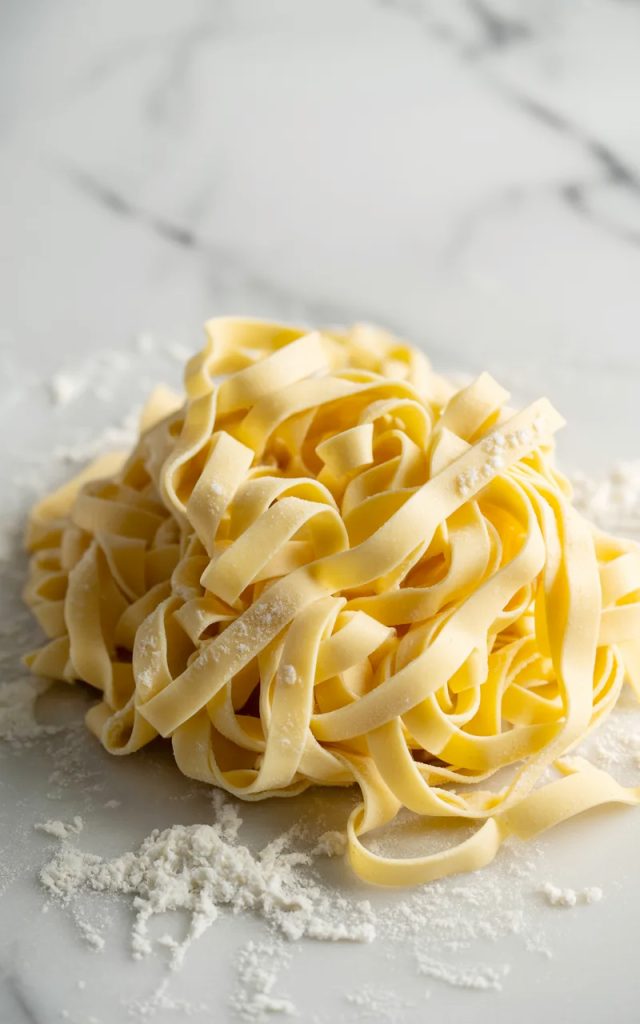
Thirty minutes later I had a pile of fresh egg noodles on my counter that cooked in four minutes and tasted like a completely different food from anything that had ever come out of a box.
Tender, slightly chewy, rich with egg, and with a texture that the dried pasta in my pantry has never once managed to deliver. That was the last time I bought egg noodles from a store, and I have a feeling this recipe is about to do the same thing to you.
For the Egg Noodles:
Key Notes:
All Purpose Flour — Standard all purpose flour is exactly what you want for this recipe. It has the right protein content to develop enough gluten for a noodle with good structure and a satisfying chew without being tough. Bread flour has too much protein and will make the noodles dense and difficult to roll. Cake flour has too little protein and the noodles will be fragile and fall apart. All purpose is the sweet spot. If you want to get slightly more precise, measure your flour by spooning it into the measuring cup and leveling off rather than scooping directly — this prevents packing and ensures you are not starting with more flour than the recipe calls for.
Eggs — Three large eggs are the primary liquid in this dough and the ingredient that gives the noodles their characteristic richness, color, and flavor. Room temperature eggs incorporate into the flour more smoothly than cold eggs. If you forget to take them out of the fridge ahead of time, a quick 10-minute soak in a bowl of warm water brings them to room temperature fast. The quality of your eggs matters more in this recipe than in most — if you can get pasture-raised or farm fresh eggs, the yolks will be a deeper, richer orange and the finished noodles will have a more vibrant golden color and a noticeably richer flavor.
Salt — Half a teaspoon of salt goes directly into the dough and seasons the noodles from the inside out. This is different from salting your pasta water, which you should also do. Salt in the dough is non-negotiable — unsalted egg noodle dough produces flat, bland noodles regardless of how good the sauce is.
Water — The water is added gradually and only as needed to bring the dough together. The exact amount depends on the size of your eggs and the humidity in your kitchen — on a dry day you might need the full four tablespoons, on a humid day you might need none at all. Start with two tablespoons, add one more at a time, and stop the moment the dough comes together into a smooth, non-sticky ball. The goal is a dough that is firm but pliable — not sticky and not so dry it cracks when you fold it.
Step 1 — Make the Dough
Mound the flour on a clean work surface or in a large mixing bowl. Make a well in the center of the flour large enough to hold the eggs. Crack the three eggs directly into the well and add the salt.
Using a fork, beat the eggs lightly within the well, then gradually start incorporating the flour from the inner walls of the well, working in small circles. Continue incorporating flour gradually until the mixture becomes too thick to work with a fork.
Switch to your hands and begin bringing the remaining flour into the dough, pressing and folding until everything comes together. If the dough feels dry and is not coming together cleanly, add water one tablespoon at a time, kneading it in fully before deciding whether you need more. The finished dough should be smooth, firm, and not sticky. If it sticks to your hands or the work surface, add a small amount of extra flour and knead it in.
Step 2 — Knead the Dough
Turn the dough out onto a lightly floured surface if you have not already done so. Knead by pushing the dough forward with the heel of your hand, folding it back over itself, rotating a quarter turn, and repeating. Knead for 8-10 minutes until the dough is smooth, elastic, and springs back when you poke it with your finger.
Do not skip or shorten the kneading step. Kneading develops the gluten network in the flour, which is what gives the noodles their structure and their satisfying chew. Under-kneaded dough produces noodles that are crumbly, soft, and lack the slightly springy bite that makes homemade egg noodles so good.
Step 3 — Rest the Dough
Shape the kneaded dough into a smooth ball. Wrap it tightly in plastic wrap or cover with an inverted bowl and let it rest at room temperature for at least 30 minutes. This rest period is not optional — it allows the gluten to relax, which makes the dough significantly easier to roll out thin without it springing back. Rested dough rolls smoothly and evenly. Un-rested dough fights you every step of the way.
If you need to, the dough can rest in the fridge for up to 24 hours. Just bring it back to room temperature for about 15 minutes before rolling.
Step 4 — Roll Out the Dough
Lightly flour your work surface. Divide the dough into two equal portions — working with the full batch at once is manageable but dividing it makes the rolling process easier and gives you more control.
Using a rolling pin, roll one portion of dough out as thin as you can get it — ideally about 1/8 inch thick or slightly thinner. Roll from the center outward in all directions, rotating the dough occasionally and adding small amounts of flour to the surface as needed to prevent sticking.
The dough should be thin enough that you can just barely see your hand through it when held up to the light. This is the thickness that gives you a tender, properly cooked noodle rather than a thick, doughy one. Repeat with the second portion of dough.
Step 5 — Cut the Noodles
Lightly dust the rolled out dough with flour and fold it loosely over itself into a flat roll — similar to rolling up a loose scroll. Using a sharp knife, cut the rolled dough into strips of your desired width. For classic egg noodles, cut strips about half an inch to three quarters of an inch wide. For a finer noodle, cut thinner.
Unfurl the cut strips and toss them gently with a small amount of flour to prevent sticking. Gather them into loose nests on a lightly floured surface or baking sheet. At this point the noodles are ready to cook immediately, or can be dried or frozen for later use.
Step 6 — Cook the Noodles
Bring a large pot of generously salted water to a rolling boil. Add the fresh egg noodles and cook for 3-5 minutes, stirring occasionally, until tender but still with a slight chew. Fresh noodles cook significantly faster than dried pasta — start tasting at the 3 minute mark and pull them as soon as they reach the texture you want.
Drain and use immediately in your recipe of choice.
The most classic use for fresh homemade egg noodles is chicken noodle soup, and there is a very good reason for that. The tenderness and richness of a fresh egg noodle in a well-seasoned chicken broth is one of the most comforting food experiences that exists. If you are making soup, add the noodles directly to the simmering broth for the last 4-5 minutes of cooking rather than cooking them separately.
Beef stroganoff is another application where homemade egg noodles shine in a way that dried pasta simply cannot match. The wide, flat noodles catch the creamy mushroom and beef sauce in every fold and crevice, and the richness of the egg dough plays beautifully against the savory, tangy sour cream sauce.
For the simplest and arguably most satisfying preparation, toss the freshly cooked noodles with a generous amount of good quality butter, a crack of black pepper, and a handful of freshly grated parmesan. That is it. Simple buttered noodles made with fresh homemade pasta is a dish that consistently surprises people with how good it is considering how little effort it requires.
If you want to take them in an Asian-inspired direction, these noodles work beautifully in a simple soy and sesame sauce with sliced green onions, a drizzle of chili oil, and a soft boiled egg on top. The egg-enriched dough stands up to bold sauces and holds its texture without getting mushy.
Fresh Noodles — Immediate Use — Fresh egg noodles can sit at room temperature on a lightly floured surface for up to 2 hours before cooking. Cover loosely with a clean kitchen towel to prevent them from drying out too quickly.
Fresh Noodles — Refrigerator — Toss the cut noodles generously with flour, loosely nest them into small portions, and store in an airtight container or zip-lock bag in the fridge for up to 2 days. The noodles will dry slightly in the fridge which is fine — they will rehydrate when cooked.
Drying the Noodles — For longer shelf life at room temperature, dry the noodles completely before storing. Spread them in a single layer on a baking sheet or hang them over a pasta drying rack and let them air dry at room temperature for 2-4 hours until completely dry and brittle. Transfer to an airtight container and store at room temperature for up to 2 weeks. Cook dried homemade noodles for 6-8 minutes in boiling salted water.
Freezing — This is my preferred storage method for big batches. Toss the cut noodles generously with flour and arrange them in small nests on a parchment-lined baking sheet. Freeze for 1-2 hours until solid, then transfer the frozen nests to a freezer-safe bag or container. Freeze for up to 3 months. Cook directly from frozen in boiling salted water for 6-8 minutes — no thawing required.
Uncooked Dough — The dough can be wrapped tightly in plastic wrap and refrigerated for up to 24 hours before rolling and cutting. Bring to room temperature for 15 minutes before rolling.
Here is what I want you to take away from this recipe. Making homemade egg noodles is not a big production. It is not a special occasion skill. It is a Tuesday evening skill — something you can pull off in the time it takes to make the rest of dinner, with four ingredients that cost almost nothing, and produce a result that is genuinely better than anything in a box or a bag.
Once you make them the first time and taste the difference, the calculation shifts permanently. Four ingredients, a rolling pin, thirty minutes. That is all that stands between you and fresh homemade egg noodles whenever you want them.
Make them this week. Toss them in butter and parmesan for the simplest possible dinner, or drop them into a pot of chicken broth and call it the best chicken noodle soup you have ever made. Either way, drop a comment below and tell me how they turned out.
Happy cooking.
— Kip
These homemade egg noodles require just four ingredients — all purpose flour, eggs, salt, and a little water — and come together in about 30 minutes with no special equipment required. The result is a tender, slightly chewy, deeply satisfying noodle with a richness and texture that dried store-bought pasta simply cannot replicate. Make them fresh for tonight's dinner or dry and freeze them for later — either way, once you make homemade egg noodles you will find it very hard to go back.