
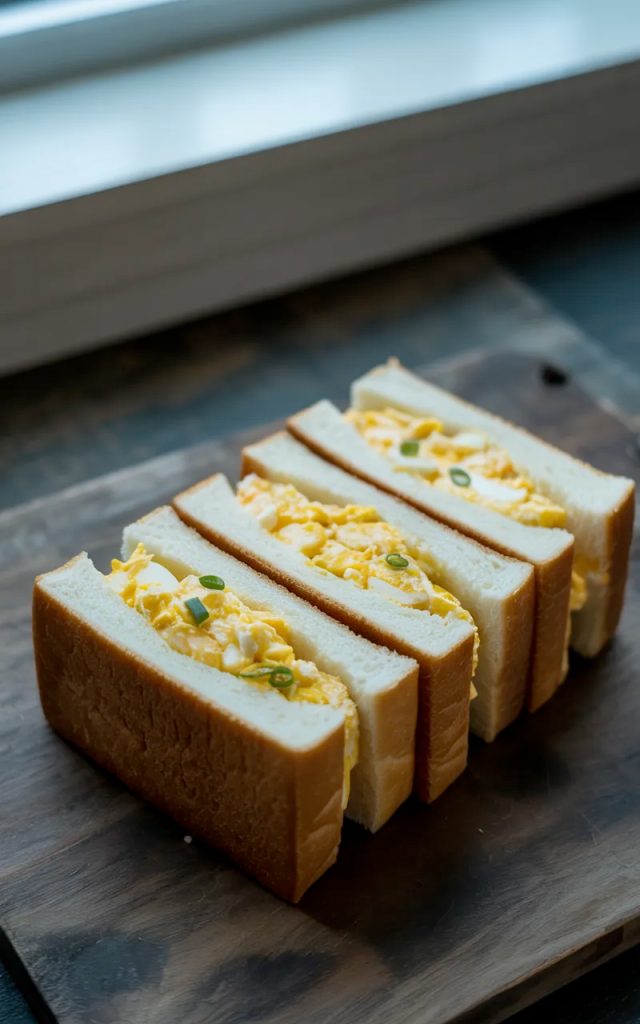
If you have never had a Japanese convenience store egg sandwich, let me paint you a picture. Imagine the softest, most pillowy white bread you have ever touched, filled edge to edge with the creamiest, richest egg salad you have ever tasted.
No unnecessary fillers, no crunchy celery, no vinegary aftertaste. Just pure, simple, perfectly seasoned egg salad that somehow manages to taste like it was made by someone who genuinely cares about sandwiches. That is the Tamago Sando.
Japan's convenience stores — Lawson, FamilyMart, 7-Eleven — are legendary for their food, and the egg sandwich sits right at the top of that list. People travel to Japan and come back talking about the convenience store egg sandwich the same way they talk about the ramen and the sushi.
That is not an exaggeration. There is something about the combination of shokupan milk bread and Japanese Kewpie mayonnaise that produces a result completely different from anything you can make with regular sandwich bread and American mayo.
The good news is you do not need a plane ticket to experience it. With the right ingredients and about 20 minutes of your time, you can make a Tamago Sando at home that holds its own against anything you would find behind the glass at a Tokyo convenience store. Let's get into it.
Ready in under 25 minutes. Boiling eggs and mixing a filling is about as straightforward as cooking gets. This is a recipe you can pull off on a busy weekday morning without breaking a sweat.
Only a handful of ingredients. Eggs, Japanese mayo, milk bread, mustard, salt, and pepper. That is essentially the whole recipe. The magic here is not in a long ingredient list — it is in the quality of what you use and how carefully you put it together.
The flavor is genuinely unlike anything else. Japanese Kewpie mayonnaise is richer, creamier, and more umami forward than any Western mayo you have used before. It transforms a simple egg salad into something that tastes deeply satisfying in a way that is difficult to describe until you try it.
Incredibly versatile. Eat it for breakfast, pack it for lunch, serve it at a brunch spread, or make a batch for a party. The Tamago Sando works in every context and suits every occasion from a quiet solo breakfast to an impressive spread for guests.
Budget friendly. Eggs and bread are two of the most affordable ingredients you can buy. This is a genuinely luxurious tasting recipe that costs almost nothing to make.
A guaranteed conversation starter. Serve these at a brunch and watch people ask what they are eating. The combination of the crustless milk bread and the creamy filling is distinctive enough that people notice it immediately and want to know more.
This is worth talking about before we get into the recipe because understanding why the Tamago Sando is different helps you make it properly rather than just making a regular egg salad sandwich and wondering why it does not taste the same.
The first difference is the bread. Shokupan, also called Japanese milk bread, is softer, slightly sweeter, and more pillowy than any standard Western sandwich bread.
It has a tender, almost cottony crumb that compresses slightly when you bite into it and then springs back. That texture is a fundamental part of the experience.
You can find it at most Asian grocery stores and increasingly at specialty bakeries. If you absolutely cannot find it, a good quality soft white sandwich bread is a passable substitute — but shokupan is genuinely worth seeking out.
The second difference is the mayonnaise. Kewpie mayo is made with only egg yolks rather than whole eggs, which gives it a richer, more golden color and a creamier, more intensely savory flavor than regular American mayo. It also has a touch of rice vinegar and MSG which adds depth and umami that standard mayo simply does not have.
It is widely available at Asian grocery stores and online and it is one of those ingredients that once you have it in your fridge you start putting it on everything. It is not interchangeable with regular mayo in this recipe — the flavor difference is significant enough that it is worth going out of your way to find it.
The third difference is the egg preparation. A classic Tamago Sando uses a combination of textures — some eggs cooked to a fully set yolk and roughly chopped, and some cooked to a jammy, slightly soft yolk that gets mashed into the mayo to create a rich, almost custardy base.
That combination of textures is what makes the filling so interesting and so much more satisfying than a standard egg salad where everything is the same consistency throughout.
Key Notes: The single most important technique in this recipe is nailing the egg cook. You want to cook your eggs in two batches — or cook them all together and divide them after — so that some have a fully set yolk for chopping and some have a jammy, slightly soft yolk for mashing.
The jammy yolks are what give the filling that rich, almost creamy base that makes a Tamago Sando taste so different from a regular egg salad sandwich. For fully set yolks, boil for 12 minutes.
For jammy yolks, boil for exactly 8 minutes. Both go into an ice bath immediately after cooking to stop the cooking process. Do not skip the ice bath — it is what keeps your jammy yolks at exactly the right consistency rather than continuing to cook from residual heat.
The Tamago Sando is one of those rare dishes that is complete entirely on its own but here are a few ways to serve it that make the experience even better:
Same day is best: The Tamago Sando is at its absolute best within an hour of making it when the bread is still fresh and the filling is perfectly set. The longer it sits the more moisture the filling releases into the bread and the softer the bread becomes.
Refrigerator: If you need to store assembled sandwiches, wrap them tightly in plastic wrap and refrigerate for up to 8 hours. Any longer than that and the bread starts to become noticeably soggy. Keep them wrapped until the moment you are ready to eat to slow down that process.
Make ahead strategy: The egg salad filling stores very well on its own. Make the filling up to 24 hours in advance and store it covered in an airtight container in the fridge. Assemble the sandwiches fresh when you are ready to eat — this is by far the best approach if you are making these for a gathering.
Do not freeze: Freezing ruins both the bread texture and the mayo based filling. These are a make fresh and eat fresh situation every time.
Peeled boiled eggs: If you want to get even further ahead, boil and peel the eggs up to 2 days in advance. Store them whole in a covered container in the fridge and make the filling the day you plan to serve.
The Tamago Sando is proof that simplicity done right beats complexity every single time. Six eggs, a few tablespoons of the right mayonnaise, the softest bread you can find, and about 20 minutes of your time — and you end up with something that people genuinely rave about.
That is not an accident. It is the result of Japanese food culture taking something ordinary and caring enough about every single detail to make it extraordinary.
Make this once and you will understand immediately why people travel halfway around the world and come back talking about a convenience store sandwich. Then make it again the following weekend because once is never enough.
From my kitchen to yours — go make something simple and make it beautifully.
With gratitude, Kip
The Tamago Sando is Japan's legendary convenience store egg sandwich — soft, pillowy milk bread filled with a creamy, rich egg salad made with Japanese mayonnaise, a touch of mustard, and perfectly cooked eggs. It sounds almost too simple to be this good. It is not. This is one of those recipes where the quality of each individual ingredient matters and the result is so much greater than the sum of its parts. Once you make it at home you will never look at a regular egg sandwich the same way again.