
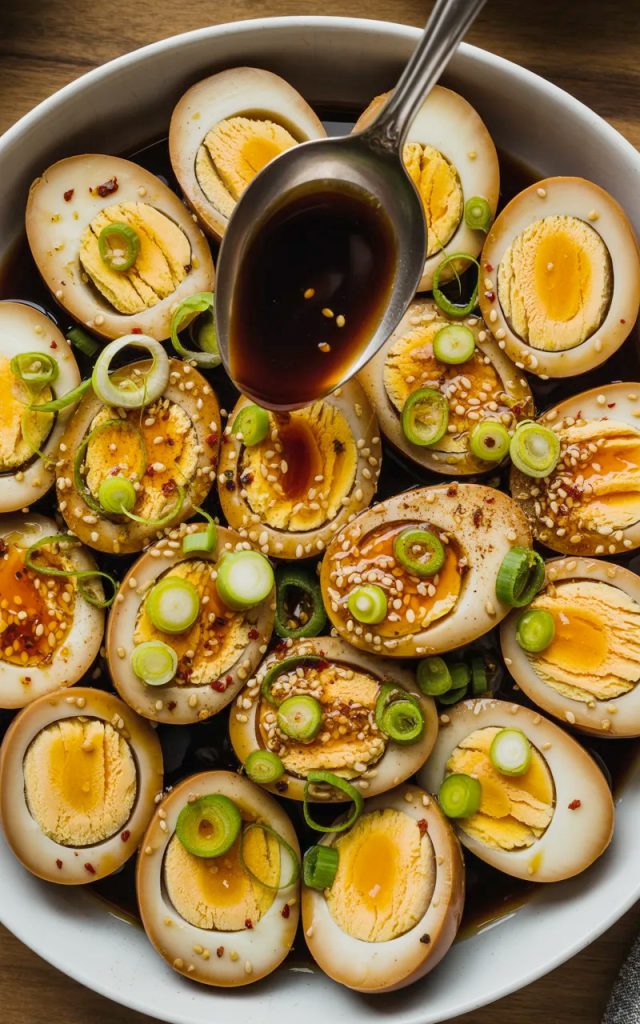
For a long time, hard boiled eggs were the most boring thing in my refrigerator. Functional, sure. High protein, absolutely. But exciting? Not even close.
They sat there in their little container being nutritious and beige and completely uninteresting until I got hungry enough to eat one plain with a pinch of salt and move on.
Then I made soy marinated eggs for the first time and my entire relationship with meal prepped protein changed overnight. Literally overnight — because that is how long you leave them in the marinade and the next morning you open the container and there they are, these beautiful deep amber glossy eggs that look like something you would pay eight dollars for at a ramen shop, sitting in your refrigerator because you spent fifteen minutes on a Sunday making them.
The flavor is genuinely remarkable for something so simple. The soy marinade penetrates the egg white completely, turning it savory and slightly sweet and complex all the way through.
You halve one and the yolk is sitting there surrounded by this beautifully stained exterior, and the whole thing tastes bold and intentional and satisfying in a way that makes plain hard boiled eggs feel like a completely different food by comparison. I make a batch every single week now and I genuinely cannot imagine going back to the plain version.
For the Hard Boiled Eggs:
For the Soy Marinade:
For Serving:
Key Notes:
Soy Sauce — Regular soy sauce gives you the deepest, most traditional flavor and the richest amber color in the finished egg. Low sodium soy sauce works but produces a slightly thinner, less complex flavor — compensate by reducing the water slightly. Dark soy sauce, if you have it, adds an even deeper color and a richer, more molasses-forward flavor that is excellent. For a gluten free version, tamari substitutes perfectly one to one without any adjustment.
Brown Sugar — Two tablespoons of brown sugar balances the saltiness of the soy sauce and adds a slight caramel sweetness that is fundamental to the addictive quality of this marinade. Honey is a slightly lighter, more floral substitute that works equally well. White sugar can be used in a pinch but lacks the depth of brown sugar. Do not skip the sweetener — the balance of salt and sweetness is what makes the marinade so compelling and what keeps you reaching for another egg.
Garlic — Smash the garlic cloves rather than mincing them. Smashed garlic releases its flavor more slowly into the marinade and produces a more rounded, less sharp garlic note in the finished eggs. Minced garlic is more aggressive and can make the marinade bitter if left for extended periods. Three cloves gives you a noticeable but not overwhelming garlic presence.
Chili Flakes — One teaspoon of chili flakes or gochugaru gives you a gentle warmth that builds slightly as you eat without overwhelming the other flavors. Gochugaru is my preferred choice — it has a slightly fruity, less sharp heat than standard red pepper flakes and gives the marinade a beautiful deep red color. Increase to two teaspoons if you like a more pronounced heat. Skip entirely for a milder version that still has all the savory, umami depth without the spice.
Sesame Oil — Toasted sesame oil added to the marinade contributes a deep, nutty aromatic quality that rounds out the flavor beautifully. Add it to the marinade after cooking rather than during — high heat diminishes its flavor. A drizzle over the finished halved eggs right before serving adds another layer of that nutty sesame aroma that makes these eggs so appealing.
Rice Vinegar — One tablespoon of rice vinegar adds a gentle acidity that brightens the marinade and prevents it from tasting flat and one-dimensional. It also very slightly tenderizes the surface of the egg white, helping the marinade penetrate more effectively during the marinating period.
Step 1 — Hard Boil the Eggs Perfectly
Fill a medium saucepan with enough water to fully submerge the eggs and bring it to a full rolling boil over high heat. Once boiling, gently lower the eggs into the water using a slotted spoon or a small strainer — lowering them gently prevents the shells from cracking on contact with the bottom of the pan.
Reduce the heat to maintain a steady gentle boil and cook the eggs for exactly 11-12 minutes for fully set yolks with no gray-green ring around them. The gray-green ring that sometimes appears around the yolk of a hard boiled egg is a sign of overcooking and sulfur release — perfect timing and an immediate ice bath prevents it entirely.
Set a timer and prepare a large bowl of ice water while the eggs cook. The moment the timer goes off, transfer the eggs immediately to the ice bath using a slotted spoon. Let them cool completely in the ice bath for at least 10 minutes — this stops the cooking process immediately and makes the eggs significantly easier to peel.
Step 2 — Peel the Eggs
Once fully cooled, peel the eggs carefully. The best technique is to gently crack the shell all over by rolling the egg on a flat surface with light pressure, then peel under a slow stream of cool running water. The water gets under the membrane between the shell and the egg white and helps the shell come away cleanly without tearing the white.
Pat the peeled eggs dry with paper towels. Dry eggs absorb the marinade more effectively than wet eggs because the marinade can make direct contact with the egg white surface rather than being diluted by surface water.
Step 3 — Make the Marinade
Combine the soy sauce, water, brown sugar, smashed garlic cloves, ginger, rice vinegar, and black peppercorns if using in a small saucepan over medium heat. Stir to dissolve the sugar and bring the mixture to a gentle simmer. Simmer for 3-4 minutes, stirring occasionally, until the sugar is fully dissolved and the garlic and ginger have begun to release their flavor into the liquid. The marinade should smell deeply savory and aromatic.
Remove from heat and stir in the sesame oil and chili flakes. Let the marinade cool to room temperature before using — adding eggs to a hot marinade can cause the whites to tighten and become rubbery on the exterior.
Taste the marinade at this point and adjust the balance. More brown sugar if you want more sweetness. More chili flakes for more heat. More rice vinegar for more brightness. The marinade should taste boldly flavored — slightly saltier and more intense than you want the finished egg to taste, since it will dilute as the eggs marinate.
Step 4 — Marinate the Eggs
Place the peeled dry eggs in a zip-lock bag or a container that holds them snugly. Pour the cooled marinade over the eggs — the eggs should be as fully submerged as possible. If using a zip-lock bag, press out the excess air before sealing so the marinade is in maximum contact with every surface of each egg.
Refrigerate for a minimum of 4 hours. For the best flavor and the most beautiful deep amber color, marinate overnight or up to 24 hours. Turn the eggs or rotate the bag once or twice during marinating if possible to ensure even color distribution.
Step 5 — Serve
Remove the eggs from the marinade and halve them lengthwise with a sharp knife for the most visually striking presentation. The exterior of the egg white should be a deep amber brown from the marinade, contrasting beautifully with the pale golden yolk in the center.
Arrange the halved eggs cut side up on a plate or in a shallow bowl. Spoon a small amount of the remaining marinade over the top of the eggs. Scatter sliced green onions and white sesame seeds generously over everything. Add extra chili flakes and a final drizzle of sesame oil for the full visual and flavor impact.
The single most satisfying way to eat soy marinated eggs is halved over a bowl of steamed white rice with the remaining marinade spooned generously over everything. The rice soaks up the savory, slightly sweet marinade and the egg yolk breaks into the rice as you eat — it is a simple combination that is deeply comforting and completely satisfying as a full meal.
For ramen, these eggs are transformative. Halve one or two and lay them cut side up in the bowl just before serving. The marinade drips into the broth and adds a savory, slightly sweet note that layers beautifully with the existing flavors. This is actually how ramen eggs are made in most Japanese ramen shops, just with a slightly different marinade ratio.
As a high protein snack, eat them straight from the container — whole or halved with a sprinkle of sesame seeds and a dash of hot sauce. They require no preparation beyond pulling them out of the fridge and are genuinely satisfying in a way that most grab-and-go snacks are not.
In grain bowls, these eggs are one of the best toppings you can add. Halve them and lay them over a base of quinoa or brown rice with whatever vegetables, greens, and sauce you have going. The marinade on the egg exterior acts as an additional seasoning for the whole bowl and makes everything taste more intentional and complete.
In the Fridge — Store the eggs submerged in the marinade in an airtight container for up to 5 days. The flavor continues to develop and deepen over the first 2-3 days and then stabilizes. After 3 days the egg whites become more deeply stained and slightly firmer in texture as the salt in the marinade continues to penetrate. All of this is perfectly safe and still delicious — it is just a slightly different texture profile than a freshly marinated egg.
Optimal Marinating Window — The sweet spot for most people is 12-24 hours. At 12 hours you get a well-flavored egg with a beautiful amber exterior and a marinade that has penetrated about halfway through the white. At 24 hours the flavor is deeper and more uniform throughout the white. Beyond 48 hours the egg white can become slightly rubbery from the salt content of the marinade.
Reusing the Marinade — The marinade can be reused once for a second batch of eggs within 3-4 days if stored refrigerated. Bring it to a boil for 2 minutes before using again to ensure food safety. After the second use, discard the marinade. Beyond two uses the marinade becomes diluted and less flavorful.
The Marinade as a Sauce — The leftover marinade after the eggs are finished is too good to throw away. Strain out the garlic and ginger solids and use it as a dipping sauce for dumplings, a drizzle over steamed broccoli or bok choy, or a quick stir fry sauce thinned slightly with water. It keeps refrigerated in a sealed jar for up to 2 weeks.
Do Not Freeze — Freezing changes the texture of hard boiled eggs significantly — the whites become rubbery and the yolks become crumbly. This is a refrigerator-only recipe.
Soy marinated eggs are one of those recipes that I genuinely wish I had discovered years earlier. Not because they are complicated or impressive in their technique — they are neither — but because of what they represent: the idea that the most boring item in your meal prep rotation can become something you actually look forward to eating, with fifteen minutes of effort and a handful of pantry ingredients.
Make a batch this Sunday. Let them marinate overnight. Open the container on Monday morning and halve one over a bowl of rice and tell me that is not one of the most satisfying things you have eaten all week.
And when you do, drop a comment below. Tell me how long you marinated them, what you ate them with, and whether you went for the spicy version. I read every single one.
Happy cooking.
— Kip
Soy marinated hard boiled eggs take perfectly cooked eggs, peel them, and submerge them in a bold savory marinade of soy sauce, garlic, ginger, brown sugar, rice vinegar, and sesame oil with a generous hit of chili flakes. The eggs absorb the marinade over several hours, turning a deep amber brown on the outside with a flavor that is savory, slightly sweet, gently spicy, and complex in a way that a plain hard boiled egg has no business matching. Make a batch on Sunday and eat them all week.