
There are ingredients that change the way you cook and then there is gochujang — the deep red Korean chili paste that somehow manages to be spicy, savory, slightly sweet, and deeply complex all at the same time.
The first time I cooked with it I genuinely could not believe what one tablespoon of this paste did to a sauce. It is one of those pantry discoveries that makes everything it touches significantly more interesting.
I started experimenting with gochujang in everything — marinades, stir fries, noodle sauces. Then one afternoon I had a batch of soft boiled eggs sitting in my fridge and a gochujang sauce bubbling on the stove, and the obvious thing happened. I put the eggs in the sauce. I let them sit for about ten minutes and then I tasted one.
That was it. Game over. The jammy, slightly runny yolk against the bold, fiery, savory-sweet sauce was a combination that hit every single flavor note at once in the most satisfying way.
I made another batch the next day. And the day after that. These spicy gochujang eggs are now one of the most requested things in my kitchen, and once you make them I am absolutely certain you will understand exactly why.
For the Soft Boiled Eggs:
For the Gochujang Sauce:
For Garnish:
Key Notes:
Gochujang — This is the soul of the entire recipe and it is worth seeking out the real thing rather than substituting. Gochujang is a fermented Korean chili paste made from red chili peppers, glutinous rice, fermented soybeans, and salt. It has a unique flavor that is simultaneously spicy, savory, slightly sweet, and deeply umami — a combination that no other chili paste fully replicates. It is available in most Asian grocery stores, in the international aisle of many mainstream supermarkets, and very easily online. Once you have a tub in your fridge it keeps for months and you will find yourself reaching for it constantly.
Soy Sauce — Use a good quality regular soy sauce for the richest flavor. Low sodium soy sauce works if you are watching your sodium intake but the sauce will taste slightly thinner and less complex. For a gluten free version, tamari is a direct one-to-one substitute that performs identically. Do not use sweet soy sauce or teriyaki sauce — the added sweetness will throw off the balance of the gochujang sauce.
Sesame Oil — Toasted sesame oil is what you want here — the dark, richly aromatic kind, not light sesame oil. It adds a deep nuttiness that is fundamental to the flavor profile of this sauce. Add most of it at the end of cooking rather than using it as the primary cooking fat — high heat diminishes the flavor of toasted sesame oil significantly. A drizzle over the finished dish right before serving adds an incredible aromatic depth.
Honey — A tablespoon of honey balances the heat and saltiness of the sauce and prevents it from being one-dimensionally spicy. Brown sugar is a good substitute with a slightly deeper, more molasses-forward sweetness. Maple syrup also works in a pinch. Do not skip the sweetener entirely — the balance between heat, salt, and sweetness is what makes this sauce as addictive as it is.
Rice Vinegar — One tablespoon of rice vinegar adds a gentle acidity that brightens the sauce and cuts through the richness of the sesame oil and gochujang. It is a subtle addition but it makes a noticeable difference in how the finished sauce tastes — without it, the flavors are slightly heavier and less vibrant.
Gochugaru — Korean red pepper flakes are optional but recommended if you want additional heat and a deeper red color in the sauce. Gochugaru has a slightly fruity, moderately spicy character that is different from regular red pepper flakes. If you cannot find gochugaru, regular red pepper flakes work as a substitute. Skip entirely if you want a milder sauce.
Step 1 — Soft Boil the Eggs
Fill a medium saucepan with enough water to fully submerge the eggs and bring it to a full rolling boil over high heat. Once boiling, gently lower the eggs into the water using a spoon or a small strainer — adding them gently prevents the shells from cracking on contact with the bottom of the pan.
Reduce the heat slightly to maintain a gentle boil rather than a violent rolling boil and cook the eggs for exactly 7 minutes. Set a timer — the difference between a 6 minute egg and an 8 minute egg is significant and 7 minutes is the sweet spot for that perfectly jammy yolk that makes these eggs so special.
While the eggs cook, prepare a large bowl of ice water — cold water with a generous amount of ice cubes. The moment the timer goes off, transfer the eggs immediately to the ice bath using a slotted spoon. Let them sit in the ice bath for at least 5 minutes. This stops the cooking process immediately and prevents the yolks from continuing to set, which is critical for maintaining that jammy texture.
Peel the eggs carefully under cool running water once they have cooled. Set aside.
Step 2 — Make the Gochujang Sauce
Add the gochujang, soy sauce, honey, rice vinegar, minced garlic, grated ginger, and water to a small saucepan over medium-low heat. Whisk everything together until the gochujang is fully dissolved into the liquid and the sauce is smooth and uniform.
Bring the sauce to a gentle simmer, stirring occasionally, for about 3-4 minutes. You are looking for the sauce to thicken very slightly, the garlic and ginger to soften slightly and mellow in flavor, and everything to come together into a cohesive, deeply flavored sauce. Do not boil the sauce aggressively — a gentle simmer is all you need and it prevents the sugars from burning.
Remove from heat and stir in the sesame oil and gochugaru if using. The sesame oil goes in off the heat to preserve its aromatic character. Taste the sauce and adjust — more gochujang for more heat, more honey for more sweetness, more soy sauce for more saltiness, more rice vinegar for more brightness.
Step 3 — Combine Eggs and Sauce
Pour the warm gochujang sauce into a bowl or shallow container that is large enough to hold all six eggs in a single layer or snugly stacked. The sauce should be deep enough to largely submerge the eggs.
Add the peeled soft boiled eggs to the sauce. Gently turn them to coat completely in the sauce. The eggs can be served immediately at this point — the warm sauce clings to the egg whites beautifully and the contrast between the warm sauce and the soft boiled egg is genuinely delicious.
For deeper flavor, cover the bowl and refrigerate for at least 30 minutes, or ideally 2-4 hours, before serving. The longer the eggs sit in the sauce the more the flavor penetrates the egg white and the more deeply colored and flavorful the outside of each egg becomes.
Step 4 — Serve
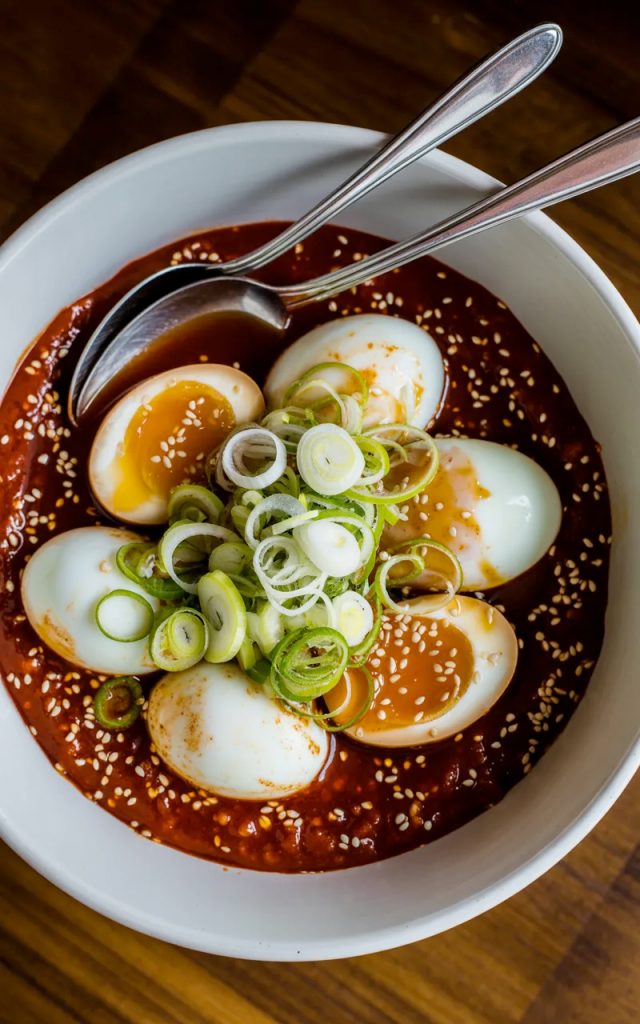
Transfer the eggs and sauce to a serving bowl. Spoon extra sauce generously over the top of each egg. Scatter sliced green onions and sesame seeds over everything. Finish with a final drizzle of sesame oil.
Serve whole for a dramatic presentation or halved to show that beautiful jammy golden yolk against the dark red sauce — the halved presentation is stunning and lets the sauce get into direct contact with the yolk.
The most satisfying way to eat these gochujang eggs is over a bowl of steamed white rice. The rice soaks up the excess sauce from the bowl, the jammy yolk breaks over the rice as you eat, and the combination of the bold spicy sauce against the neutral, slightly sticky rice is one of the most comforting food experiences in my kitchen.
For a complete meal, add the eggs to a grain bowl with steamed rice or quinoa, sliced cucumber, shredded carrots, and a handful of baby spinach. Drizzle the gochujang sauce from the bowl over everything as the dressing. It is a simple, nutritious, and genuinely delicious bowl that comes together in about 15 minutes if the eggs are already made.
These eggs are one of the best ramen toppings you can make. Halve them and lay them cut-side up in a bowl of your favorite ramen — the yolk mixes with the broth and the gochujang sauce adds a layer of flavor that takes the whole bowl in a bold new direction.
For a snack or appetizer situation, serve them whole in the bowl of sauce with small spoons for scooping and extra sliced green onions and sesame seeds scattered generously on top. Set them out at a gathering and watch people crowd around the bowl — they are visually dramatic and the flavor is completely addictive.
In the Fridge — Store the eggs submerged in the gochujang sauce in an airtight container in the fridge for up to 4 days. As the days pass, the sauce penetrates deeper into the egg white and the color deepens from a pale stained exterior to a more deeply pigmented, more intensely flavored egg. Day two and day three eggs are arguably the best — fully infused with flavor but still with that jammy yolk texture intact.
Flavor Development — If you have the patience, make these eggs the night before you plan to eat them and let them marinate overnight. The overnight marination produces an egg that is fundamentally different from one eaten immediately — more flavorful, more deeply colored, and more complex. If you are meal prepping, making these on Sunday and eating them through the week is a genuinely excellent strategy.
Storing Eggs and Sauce Separately — If you plan to keep them longer than 3 days, storing the eggs and sauce separately is a good option. The eggs store well in a separate container for up to 5 days and the sauce keeps refrigerated for up to 2 weeks. Reheat the sauce gently and add the eggs when ready to serve.
Do Not Freeze — The texture of soft boiled eggs deteriorates significantly after freezing. The whites become rubbery and the jammy yolk loses its characteristic texture entirely. This is strictly a fresh or refrigerated recipe.
Sauce Only — If you make extra sauce, it keeps refrigerated in a sealed jar for up to 2 weeks and is incredibly versatile. Use it as a stir fry sauce, a marinade for chicken or tofu, a dipping sauce for dumplings, or a drizzle over roasted vegetables. It is one of those multi-purpose sauces that earns its place in your fridge.
Gochujang eggs are one of those recipes where the payoff is completely disproportionate to the effort. Twenty minutes, one sauce, six eggs, and you have something that is bold and complex and visually stunning in a way that a simple list of ingredients has absolutely no right to produce.
Make them on a Sunday. Let them sit overnight. Eat them over rice on Monday morning and tell me that is not one of the best breakfasts you have had all week. Then make another batch because you will want them again by Tuesday.
Drop a comment below and let me know how you served yours — over rice, in ramen, or straight from the bowl at midnight. All three are valid and I genuinely want to hear about it.
Happy cooking.
— Kip
These spicy gochujang eggs take perfectly soft boiled eggs with jammy, slightly runny yolks and nestle them in a bold, deeply flavored Korean-inspired sauce made with gochujang, soy sauce, sesame oil, garlic, ginger, and a touch of honey. The sauce is spicy, savory, slightly sweet, and packed with layers of flavor that cling to every soft boiled egg in the bowl. Ready in 20 minutes, they get better the longer they sit, and they work as a snack, a side, a topping for rice, or the best thing you have ever put on a grain bowl.