

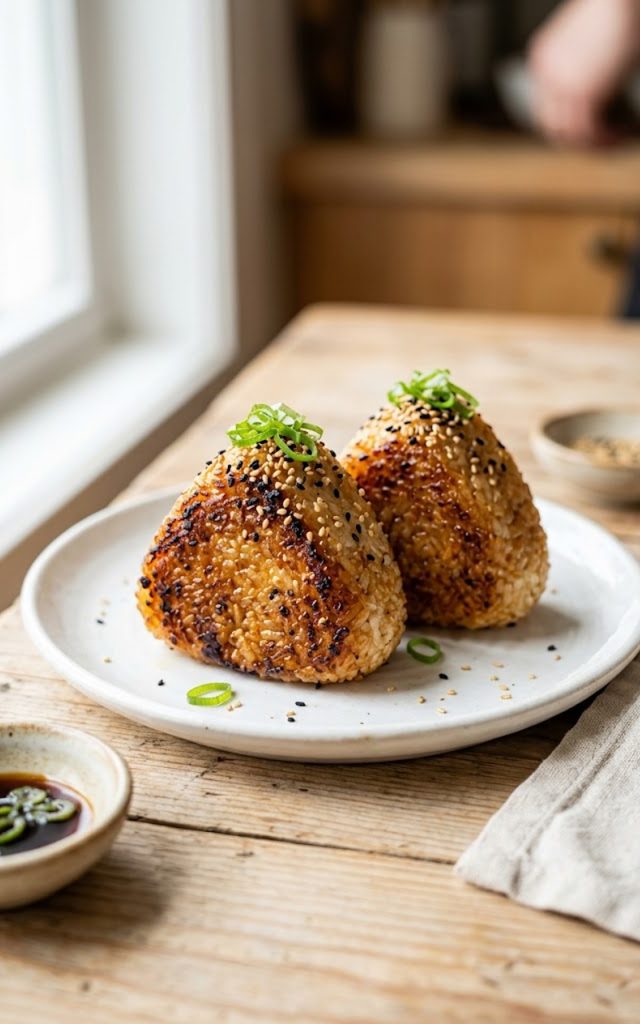

If you’ve never had yaki onigiri, let me be the one to change your life today. These Japanese grilled rice balls are crispy on the outside, soft and chewy on the inside, and brushed with a savory soy sauce glaze that makes them almost impossible to eat just one of. And the best part? You only need a handful of ingredients to make them.
I stumbled onto yaki onigiri during a late-night recipe rabbit hole — you know the kind where you start looking up one thing and three hours later you’re deep into Japanese street food culture. I made them the very next morning and honestly, they’ve been on my regular rotation ever since. Simple, satisfying, and surprisingly comforting for something so minimal.
Whether you’re looking for a quick snack, a light lunch, or a side dish that’ll make your dinner feel a little more special — this is it. Let’s make some rice balls.
Why you’ll love this recipe
- Only four ingredients — short grain rice, soy sauce, oil, and optional furikake
- The crispy soy-glazed exterior is absolutely addictive
- Totally customizable — stuff them with whatever filling you like
- Ready in about 30 minutes if your rice is already cooked
- Works as a snack, lunch, side dish, or even a light dinner
- A great way to use up leftover rice — zero waste cooking at its finest
Ingredients with key notes
For the rice balls
- 2 cups short grain Japanese rice — this is non-negotiable. Short grain rice has the right stickiness to hold the shape. Long grain or jasmine rice will fall apart on you, and that’s a headache nobody needs
- 2 and 1/4 cups water — for cooking the rice perfectly
- 1 teaspoon salt — to season the rice before shaping
For grilling and glazing
- 1-2 tablespoons neutral oil — vegetable oil, canola oil, or sesame oil all work great. Sesame oil adds an extra nutty depth if you want to go that route
- 3 tablespoons soy sauce — use a good quality soy sauce here since it’s doing a lot of the flavor heavy lifting. For a gluten free version, swap this for tamari
- 1 teaspoon mirin — optional but adds a subtle sweetness to the glaze that works really well
- 1 teaspoon sesame oil — for brushing at the end for extra flavor
Optional but highly recommended
- Furikake — a Japanese rice seasoning blend of sesame seeds, dried seaweed, and other seasonings. You can find it at most Asian grocery stores or online. It takes these rice balls to a completely different level
- Sesame seeds — for garnish
- Sliced green onions — for garnish
Optional fillings
- Canned tuna mixed with mayo
- Pickled plum (umeboshi)
- Salmon flakes
- A small piece of nori seaweed tucked inside
Step-by-step instructions
Step 1: Cook the rice
Rinse your short grain rice under cold water until the water runs clear — this removes excess starch and keeps the rice from getting too gummy. Cook according to package instructions or use a rice cooker if you have one. Once cooked, season with salt and let it cool slightly until it’s comfortable to handle but still warm. Cold rice is harder to shape and won’t hold together as well.
Step 2: Shape the onigiri
Wet your hands with cold water and sprinkle a little salt on your palms — this prevents sticking and seasons the outside of the rice ball. Grab about half a cup of rice and press it firmly into a triangle shape using both hands. Apply firm, even pressure from all sides. The goal is a compact triangle that holds its shape without crumbling. If you’re adding a filling, press a small indent into the center of the rice, add your filling, then cover it with a little more rice and reshape.
Step 3: Heat the pan
Heat a non-stick skillet or cast iron pan over medium heat and add your oil. You want the pan properly heated before the rice balls go in — a cold pan means the rice will stick and tear instead of forming that beautiful crust we’re going for.
Step 4: Grill the rice balls
Place the shaped onigiri in the pan and let them cook undisturbed for about 3-4 minutes on the first side until a golden crispy crust forms. This is the part where patience actually pays off. Resist the urge to move them around — let the crust develop fully before flipping. Carefully flip them and cook for another 3-4 minutes on the second side. Then stand them on their third flat edge and cook for 2-3 minutes to crisp that side up too.
Step 5: Apply the soy sauce glaze
Mix together the soy sauce and mirin in a small bowl. Once all sides of the onigiri are nicely golden and crispy, brush the soy sauce glaze generously over every side. The glaze will sizzle and caramelize almost immediately — that smell alone is worth making this recipe for. Let each glazed side sit in the pan for about 30-60 seconds to let the glaze set and darken slightly before flipping to glaze the next side.
Step 6: Finish and garnish
Remove the onigiri from the pan and brush lightly with sesame oil for an extra layer of flavor. Sprinkle with furikake, sesame seeds, and sliced green onions. Serve immediately while they’re still hot and crispy — these are at their absolute best straight out of the pan.
Serving suggestions
Yaki onigiri are incredibly versatile. Here are a few ways to enjoy them:
- Serve them as a standalone snack with a side of pickled vegetables for a light, satisfying bite
- Pair them with a bowl of miso soup for a simple, comforting Japanese-inspired meal
- Add them as a side dish alongside grilled teriyaki chicken or salmon for a complete dinner
- Serve them on a sharing platter at a gathering with small dipping bowls of extra soy sauce and sesame oil on the side
- Pack them in a lunchbox — they travel surprisingly well and taste great at room temperature
- Top them with a soft poached egg and a drizzle of sriracha for a next-level breakfast situation
Storage tips
At room temperature: Yaki onigiri are best eaten fresh and hot. If you need to hold them for an hour or two, keep them at room temperature loosely covered — not in an airtight container, which will steam them and make them soggy.
In the refrigerator: Store leftover onigiri in an airtight container in the fridge for up to 2 days. The crust will soften in the fridge, but don’t worry — they reheat beautifully.
Reheating: To bring back the crispy crust, reheat them in a dry non-stick pan over medium heat for 2-3 minutes per side. You can also use an air fryer at 375 degrees F for about 5 minutes. The microwave works in a pinch but you’ll lose the crispiness — fair warning.
Freezing: You can freeze ungrilled shaped onigiri for up to 1 month. Wrap each one individually in plastic wrap and store in a zip-lock freezer bag. Thaw in the fridge overnight, then grill fresh when you’re ready to eat. Do not freeze already grilled onigiri as the texture suffers significantly.
Leftover rice tip: If you have leftover cooked rice in the fridge, this is the perfect recipe to use it up. Just make sure to bring it to room temperature before shaping so it’s pliable enough to hold together.
Let’s wrap this up
Yaki onigiri is one of those recipes that sounds fancy but is actually one of the most approachable things you can make in the kitchen. Four ingredients, one pan, and about 30 minutes stand between you and some of the most satisfying crispy rice you’ll ever eat.
This is exactly the kind of recipe that reminds me why I fell in love with cooking in the first place — taking something simple and turning it into something that genuinely makes people stop and say “wait, what is this?” If you’ve never made onigiri before, this is your sign to start.
Give it a try and let me know how it goes. Drop a comment below, tag me on Instagram, or share your creation on Pinterest. I read every single one and I genuinely love seeing what you make.
Until the next recipe — keep it simple, keep it delicious.
With love from my kitchen to yours, Kip
Yaki Onigiri (Grilled Rice Balls) — Crispy, Savory, and Incredibly Easy to Make
Description
Yaki onigiri are Japanese grilled rice balls made from short grain rice shaped into triangles, then pan-fried or grilled until a golden crispy crust forms on the outside. Brushed with a simple soy sauce glaze and finished with a sprinkle of furikake, these rice balls are the perfect balance of crispy, chewy, savory, and satisfying. They're incredibly easy to make, require minimal ingredients, and work beautifully as a snack, side dish, or light meal.
Ingredients
For the rice balls:
For grilling and glazing:
Optional garnish:
Instructions
-
Rinse rice until water runs clear then cook according to package instructions. Season with salt and cool slightly.
-
Wet hands, sprinkle salt on palms, and shape rice into compact triangles using about half a cup of rice each.
-
Heat oil in a non-stick pan over medium heat.
-
Grill onigiri for 3-4 minutes per side undisturbed until golden and crispy on all three sides.
-
Mix soy sauce and mirin then brush generously over all sides, letting the glaze caramelize for 30-60 seconds per side.
-
Remove from pan, brush with sesame oil, and garnish with furikake, sesame seeds, and green onions. Serve immediately.